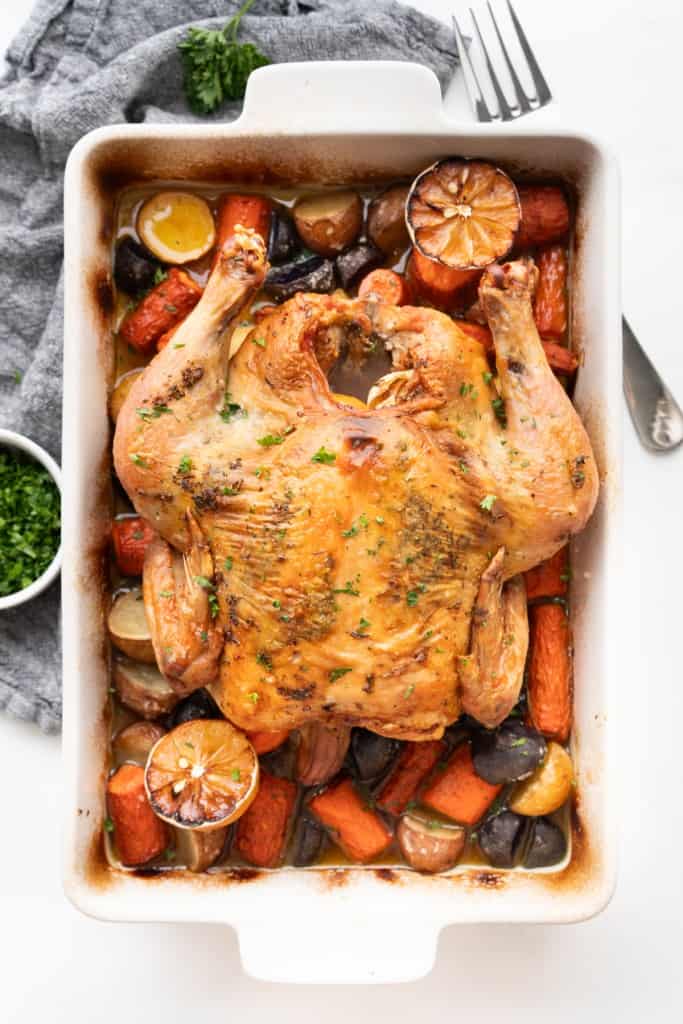
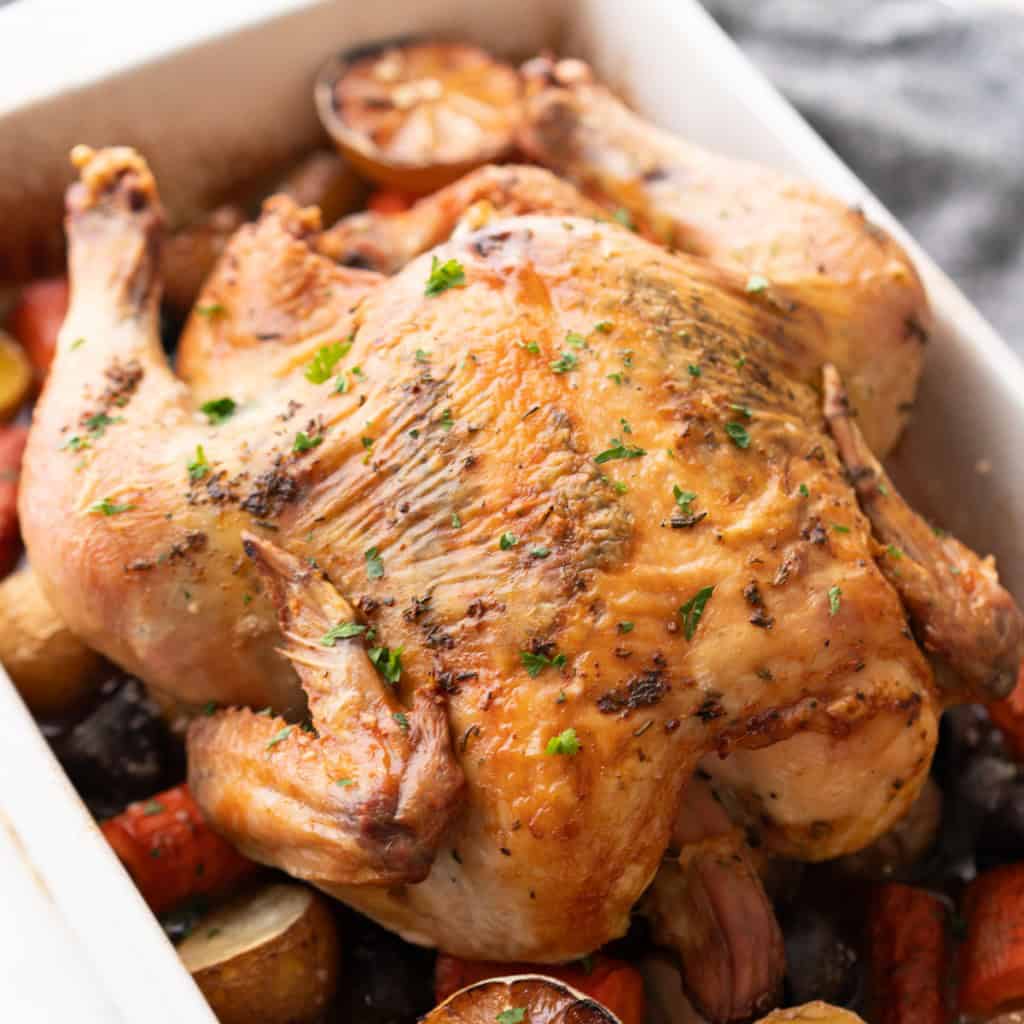
This Roasted Chicken and Vegetables is a cozy dinner that combines juicy, flavorful whole chicken with golden skin, roasted alongside your favorite root vegetables all in one pan.
This whole chicken is dry brined for extra crispy skin, rubbed with garlic herb butter, and roasted with lemon, garlic, carrots and baby potatoes. Total prep/active time to make this dish is only about 30 minutes, however, you’ll want to dry brine the chicken 24 hours in advance for most optimal flavor.
Why I Love This Roasted Chicken And Vegetables Recipe
I was so intimidated about roasting a whole chicken for the longest time. I finally gave it a try a few years ago, and honestly, it really wasn’t that bad! In fact, I truly stopped buying rotisserie chicken from the grocery stores since then. Not trying to brag, but my roasted whole chicken is so much better!
I love roasting my whole chicken with root veggies at the bottom to get both my protein and veggies all cooked at once. It’s also an easy way to get a full, well-rounded meal on the table.
There’s something about pulling a golden roasted whole chicken and vegetables out of the oven that makes any dinner feel a little more special. And yet, most of the work is pretty simple, and not as intimidating as it looks!
Chicken comes out truly moist and flavorful – we don’t approve of dry, bland chicken in our household! 😉
The secret is a simple dry brine plus a generous layer of garlic herb butter tucked right under the skin. That’s how you get a whole roasted chicken that’s seasoned all the way through, not just on the surface.
Since the chicken roasts right on top of carrots and baby potatoes, its droppings, along with the chicken stock in the pan, will cook the veggies until they are tender and flavorful. Not only that, you get your protein and vegetables all in one dish. Main and sides, done! 🙌
Start with the dry brine where the salt does its magic in the fridge, and the oven takes care of the rest. No flipping, no babysitting, no complicated techniques, no fancy equipments.
The two-temperature roast is another little trick that makes a big difference. A quick blast of high heat gets the skin going, then a lower temperature lets the meat cook through gently so it stays juicy.
If one-pan chicken dinners are your thing, you’ll also love my One-Pan Greek Lemon Chicken and Potatoes, Sheet Pan Chicken Thighs and Veggies, and Skillet Chicken and Potato.
If you prefer smaller chicken pieces instead of a whole chicken, see variation section below for more detailed instructions. Or check out my braised chicken thighs recipe!
What Is Dry Brining?
Dry brining just means salting meat ahead of time and letting it rest in the fridge before cooking. Unlike wet brine – no need to mess with buckets of salty water!
The salt first draws moisture out of the chicken, then that salty liquid gets reabsorbed back into the meat, seasoning it more deeply than a last-minute sprinkle ever could.
Leaving the chicken dry and uncovered also dries out the skin, which is exactly what helps a whole roasted chicken turn out extra crispy.
Kitchen Tools
Here’s what you’ll need to make this recipe:
- Baking rack: Sits inside the sheet pan during the dry brine so air can circulate all around the chicken and the skin dries evenly.
- Half sheet baking pan: Holds the rack and catches any drips while the chicken rests in the fridge.
- Baking dish: Choose one large enough to hold the chicken with the carrots and potatoes spread out around it.
- Small mixing bowl: For stirring together the garlic herb butter.
- Pastry brush: Makes it easy to coat the skin evenly with oil.
- Meat thermometer: The easiest, most reliable way to know your chicken is done. No guessing and no cutting into it to check!
Ingredients
For the Dry Brine
- Whole chicken: A standard whole chicken from the grocery store works perfectly. Check the recipe card for the size, since that’s what the salt and cook time are based on. Make sure the chicken is completely thawed before brining. If a chicken is frozen, you will want to leave it in the refrigerator for ~48 hours for it to fully thaw.
- Salt: The only ingredient in the dry brine! It seasons the meat from the inside out and helps dry the skin for maximum crispiness. Salt crystal sizes vary a lot between types and brands, so if you’re using fine table salt, stay on the lighter end of the range.
For the Garlic Herb Butter
- Salted butter: Make sure it’s softened so it mixes easily and spreads under the skin without tearing it. I typically prefer salted butter but if unsalted is all you have that works just fine too!
- Garlic: Freshly minced cloves give the butter the best flavor.
- Fresh thyme: Adds an earthy, savory note that’s classic with roast chicken.
- Fresh rosemary: Brings a woodsy, piney flavor. Mince it finely so you don’t end up with big, tough bits.
For the Vegetables
- Carrots: Chop them into chunks roughly the same size as the halved potatoes so everything cooks evenly. Other root veggies work great too – add your favorite!
- Baby potatoes: Halved, they turn creamy inside and hold their shape nicely while roasting.
- Cooking oil: Any neutral oil works, like avocado or vegetable oil.
- Salt: Seasons the veggies so they’re flavorful all on their own.
- Chicken stock: Poured over the veggies so they stay tender, and it mingles with the drippings to create delicious pan juices. Low-sodium stock is a great option if you’re watching the salt.
For the Chicken
- Cooking oil: A light brush over the skin helps it brown beautifully. Use any neutral oil such as avocado oil, canola oil, vegetable oil etc.
- Lemons: Halved, with some tucked into the cavity and some nestled in with the veggies. They add a bright, fresh flavor to both. The ones nestled in the veggies can be juiced onto chicken after roasting if you like a touch of citrus on the roasted chicken.
- Garlic head: Cut in half across the middle to expose all the cloves, then stuffed into the cavity for extra aromatic flavor.
- Extra herb sprigs (optional): Any leftover thyme and rosemary sprigs can go in the cavity and around the vegetables.
How To Make Roasted Chicken And Vegetables
Step 1: Dry brine the chicken
Place a baking rack inside a sheet pan and set the whole chicken on top (don’t forget to remove the giblets if they’re tucked inside!).
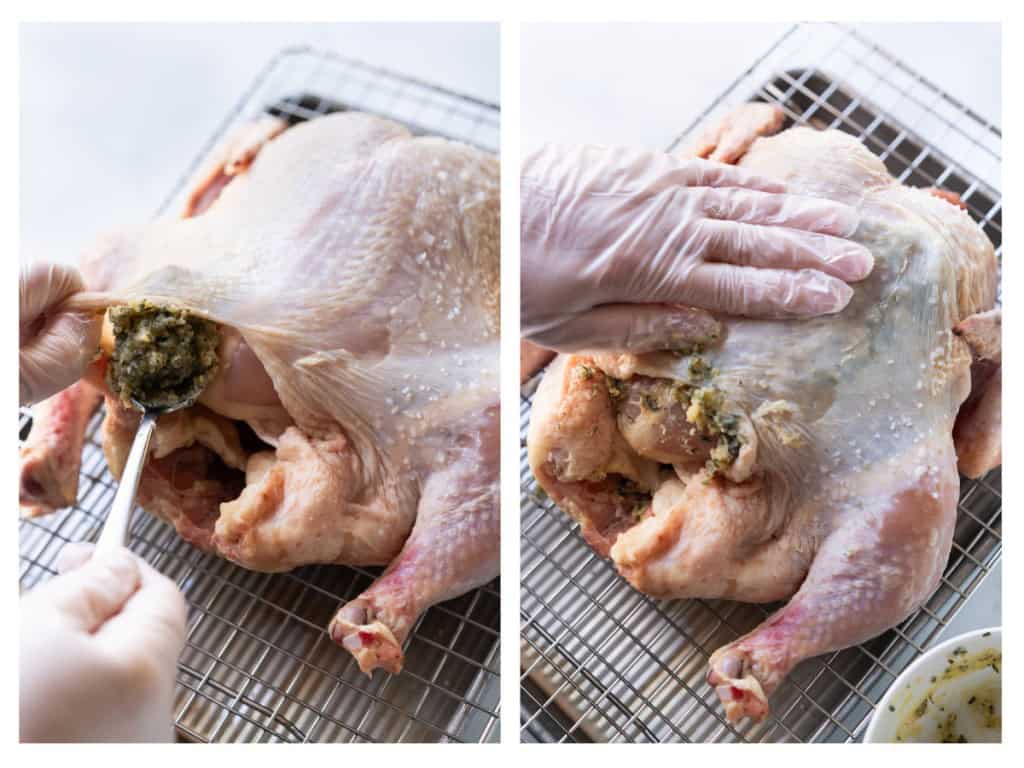
Generously sprinkle salt over the chicken, including under the skin, making sure to cover every side.
Pop it in the fridge, uncovered, for 12-24 hours.
Take the chicken out of the fridge about 30 minutes before cooking so it can come closer to room temperature.
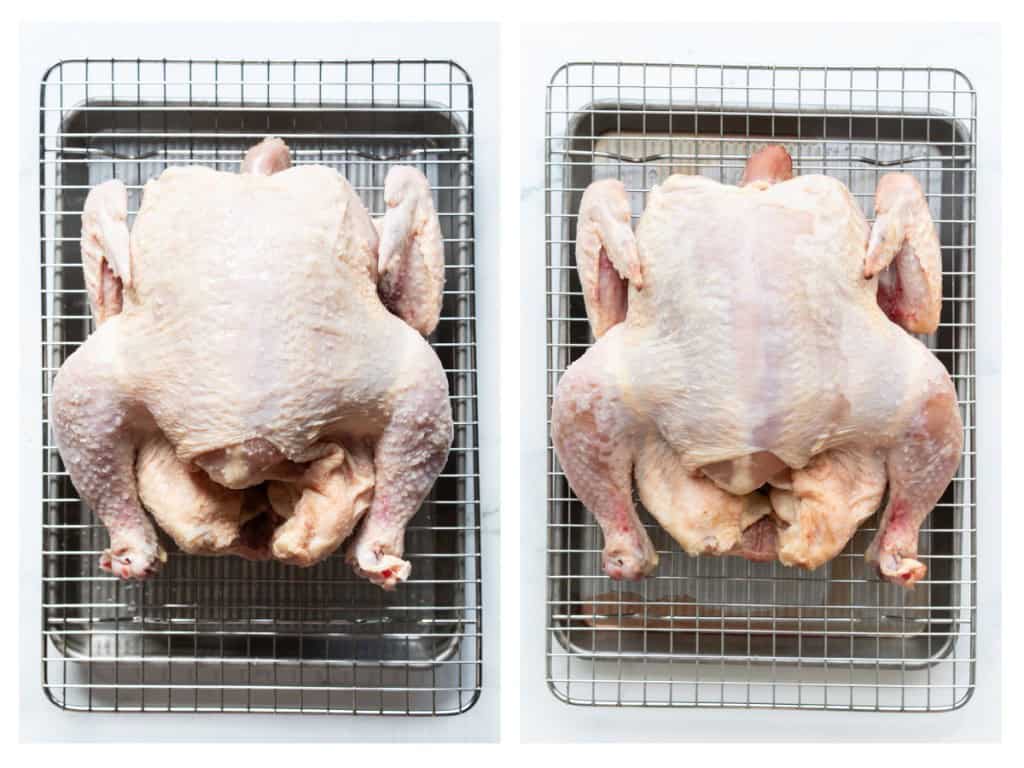
Check out the before and after dry brining. The difference is small but if you look closely, the chicken skin in the after shot (on the right) is dried up and thinner because the salt draws out surface moisture from the chicken skin.
Step 2: Make the garlic herb butter
In a small mixing bowl, add the softened salted butter, garlic, thyme, and rosemary. Mix until everything is fully combined.
Step 3: Prep the vegetables
Preheat the oven to 425°F.
While the oven heats up, add the carrots and baby potatoes to the baking dish. Toss with cooking oil and salt.
Step 4: Butter and stuff the chicken
Gently loosen the skin with your fingers, then stuff the garlic herb butter underneath, spreading it around as best you can.
Getting it into every nook and crannies will really help flavor every part of the chicken!
Set the chicken on top of the carrots and potatoes.
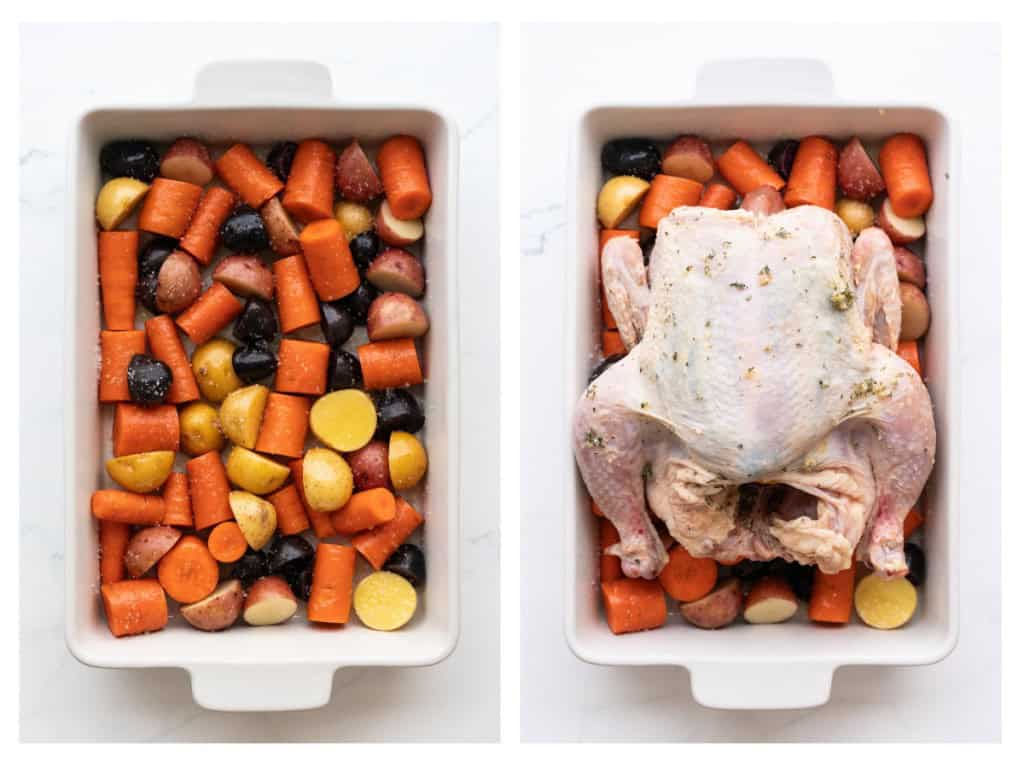
Stuff two lemon halves and both garlic head halves into the cavity, along with any extra sprigs of thyme and rosemary if you have them.
Step 5: Brush with Oil Add the stock
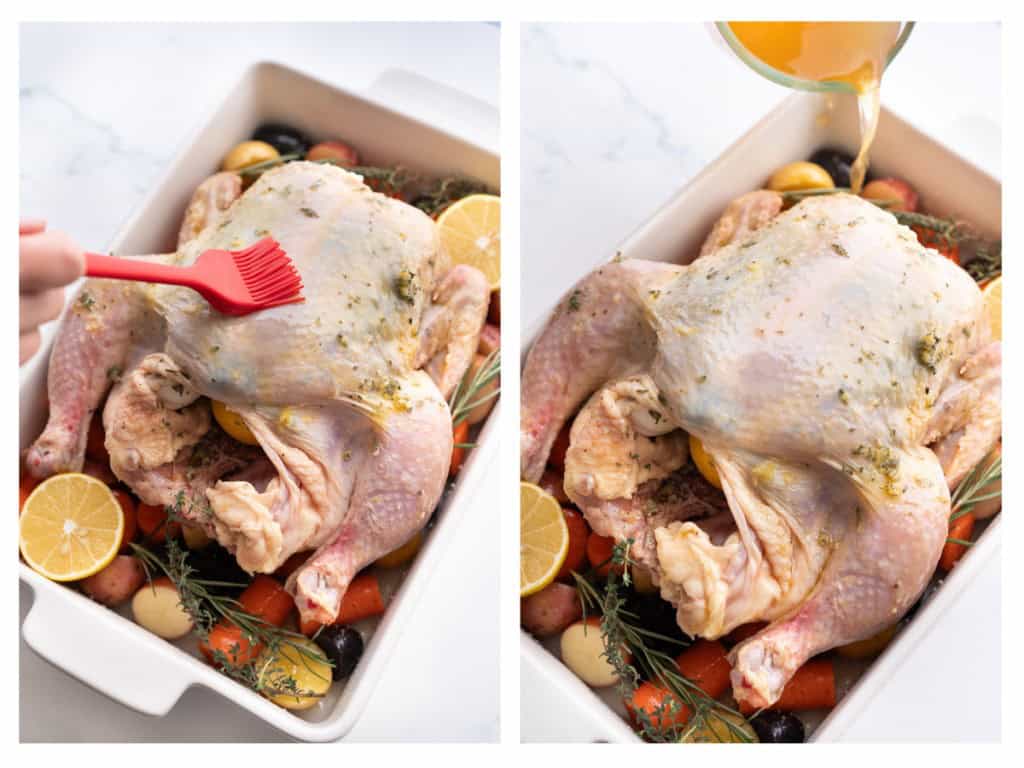
Brush the whole chicken with a neutral oil – this will help give a nice golden brown color to the skin, and it will also help it crisp up nicely.
Pour the chicken stock over the carrots and potatoes, aiming around the chicken rather than over it so the skin stays dry.
Nestle the remaining two lemon halves in with the vegetables. You can add a few herb sprigs here too.
Step 6: Roast
Bake for 15 minutes, then reduce the oven temperature to 350°F.
Continue baking for about 1 hour 15 minutes, or until the internal temperature reaches 165°F using a meat thermometer.
To check for doneness, check the thickest part of the breast, without touching the bone.
Step 7: Rest, carve, and serve
Once fully cooked, remove the chicken from the oven and let it rest for at least 15 minutes (or longer if you have time) before carving.
This gives the juices time to settle back into the meat instead of running all over your cutting board – it will also ensure chicken is juicy and tender.
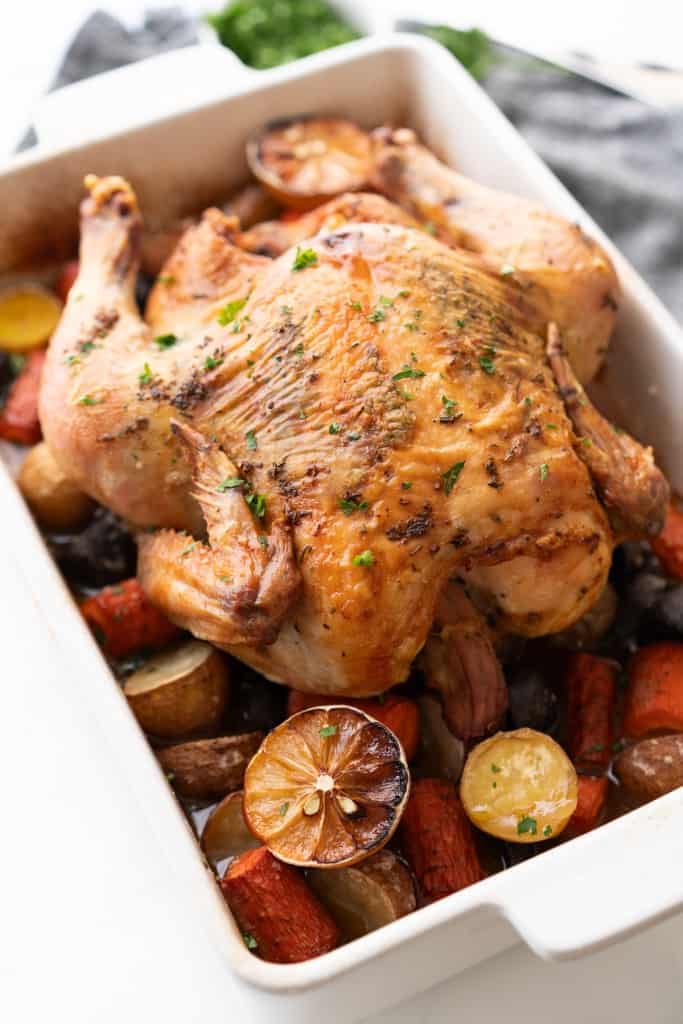
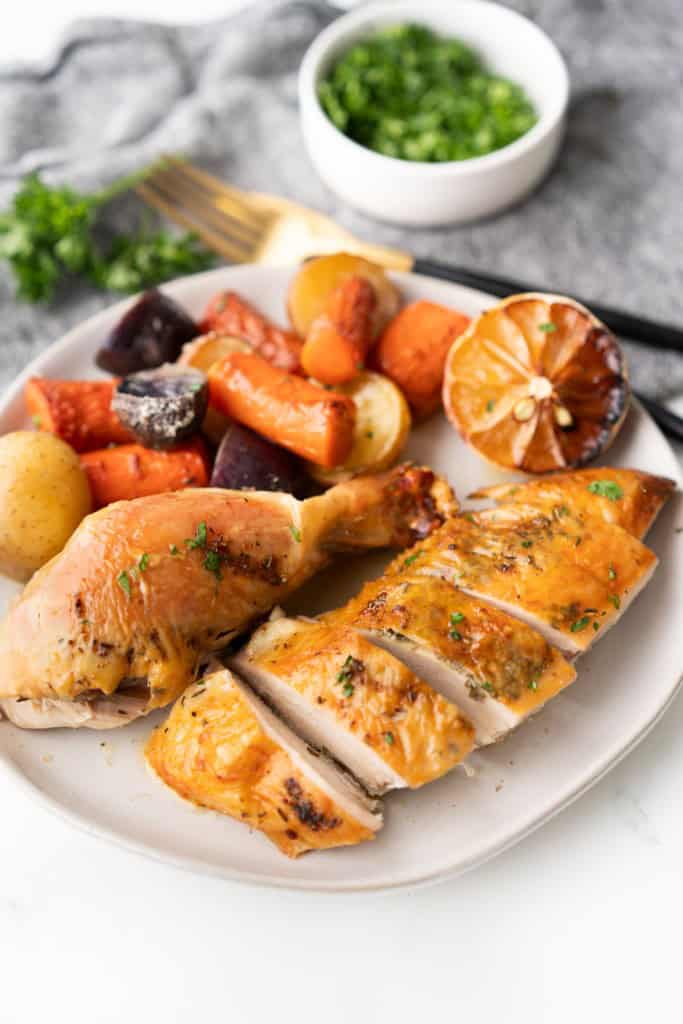
Last but certainly not least, carve the whole chicken and serve it with the veggies and a spoonful of those pan juices.
Once you try this once, you’ll quickly realize that making a whole roasted chicken isn’t as intimidating as it looks! Pinky promise. <3
Variations And Substitutions
- Other veggies: Onions or other root veggies such as parsnips, turnips, radishes, sweet potatoes, or butternut squash all roast beautifully alongside the chicken. Just cut them to a similar size so everything finishes at the same time.
- Different herbs: Swap in sage or oregano, or use a mix of your favorites.
- Citrus swap: Try oranges instead of lemons for a slightly sweeter twist. Or omit it completely if you don’t have it on hand – it won’t make too much of a difference!
- Extra flavor in the butter: Stir in a little smoked paprika or lemon zest for a fun variation.
- Chicken pieces: Bone-in, skin-on thighs and drumsticks work too. They’ll cook faster than a whole chicken, so go by your thermometer rather than the clock.
Make Ahead, Storage, And Reheating
Make ahead: The dry brine is built-in prep work, since the chicken needs to sit in the fridge anyway. You can also mix the garlic herb butter and chop the carrots a day ahead and refrigerate them. Just let the butter soften before using.
Storage: Store leftover chicken and vegetables in an airtight container in the fridge for up to 3-4 days.
Freezing: Carved chicken freezes well for up to 3 months. The potatoes can turn a bit grainy after freezing, so they’re best enjoyed fresh or from the fridge.
Reheating: Warm leftovers in a 350°F oven, covered with foil and a splash of chicken stock to keep everything moist. The microwave works in a pinch too.
How To Serve
This roasted chicken and vegetables dinner already has both your protein and veggies covered, so you really don’t need anything else. However, a batch of Gravy From Scratch and some soft Cheese Stuffed Dinner Rolls or Milk Bread Rolls can never go wrong!
Want something green on the table? Roasted Broccolini, Honey Balsamic Brussels Sprouts, or a fresh Kale and Brussels Sprouts Salad all round out the meal nicely.
Tips and Tricks
- Dry brine salt to chicken ratio: The rule is typically 1 tsp of salt to 1 lbs of chicken.
- Pat the chicken dry first: Blot it all over with paper towels before salting. Less surface moisture means crispier skin.
- Leave it uncovered in the fridge: It might feel strange, but air-drying the skin is exactly what helps it crisp up in the oven.
- Loosen the skin gently: Slide your fingers slowly between the skin and meat to make room for the salt bring and eventually butter. Take your time so the skin doesn’t tear.
- Keep the butter soft, not melted: Softened butter stays put under the skin, while melted butter tends to run right out.
- Cut the veggies evenly: Similar-sized pieces of carrot and potato cook at the same rate, so you won’t end up with some mushy and some firm.
- Pour the stock around the chicken: Keeping liquid off the skin is key to getting it golden and crispy.
- Roasting time rule: After roasting it at 450ºF for 15 minutes, drop the temperature down to 350ºF and roast it for ~20 minutes per pound of chicken.
- Trust a thermometer: Use the time rule as a guideline to check on the chicken. A meat thermometer takes all the guesswork out and will determine when to actually pull the chicken out of the oven. Check the thickest part of the thigh without touching the bone.
- Don’t skip the rest: About 10-15 minutes before carving is a good window for the juices to settle back into the meat after taking it out from the oven.
- Spoon on the pan juices: The stock and drippings in the bottom of the dish are liquid gold. Drizzle them over the carved chicken and veggies!
- Save the bones: Simmer the leftover carcass with water and a few veggie scraps for homemade chicken stock.
Frequently Asked Questions
It’s highly recommended, since it’s what makes the meat so flavorful and the skin so crispy. If you’re short on time, even a few hours in the fridge helps, or you can salt the chicken right before roasting. The skin just won’t get quite as crispy and the flavor won’t penetrate into the meat as much.
No. Rinsing raw chicken can splash bacteria around your sink and kitchen, and it’s not needed. Patting it dry with paper towels is all you need to do.
The internal temperature should reach 165°F in the thickest part of the thigh. The juices should also run clear rather than pink.
Moisture is often the culprit. Make sure the chicken is patted dry, left uncovered during the dry brine, and that the stock is poured around the chicken rather than over it.
Yes. Dried herbs are more concentrated, so use about one-third of the amount. Fresh herbs do give the brightest flavor, though, so use fresh if you are able.
Yukon gold potatoes cut into chunks work great. Russets tend to break down more during roasting, so they’re not the best fit here.
You can, but it may not be the best fit for that because the pan juices are diluted since there’s also chicken broth in the pan. You can however, make gravy without drippings.
Leftovers are SO versatile. Shred the chicken for sandwiches, salads, wraps, or soups throughout the week.
ENJOYED THIS RECIPE? Tell us what you think by leaving a rating and review below! 🤍
More Chicken Recipes You’ll Love
- Creamy Coconut Lime Chicken
- Lemon Butter Chicken
- Chicken Burgers
- Puff Pastry Chicken Pot Pie
- Homemade Chicken Noodle Soup
- Slow Cooker Chicken Stew
Roasted Chicken and Vegetables
Ingredients
Dry Brine
- 4-5 lb whole chicken
- 4-5 tsp salt
Garlic Herb Butter
- 4 tbsp salted butter softened
- 4 cloves garlic minced
- 1 tbsp fresh thyme minced
- 1 tbsp fresh rosemary minced
Vegetables
- 2 lbs carrots chopped
- 1.5 lbs baby potatoes halved
- 1 tbsp cooking oil
- 2 tsp salt
- 2 cups chicken stock
Chicken
- 1 tbsp cooking oil
- 2 lemons halved
- 1 head garlic halved
Instructions
- Place a cooking rack in a sheet pan. Put whole chicken on top of the rack. Gently loosen the skin of the chicken. Generously salt chicken making sure to salt all sides, and also underneath the skin. Let sit uncovered in the refrigerator for 12-24 hours. Take out of the refrigerator 30 minutes before cooking.
- In a small mixing bowl, add softened butter, garlic, thyme, and rosemary. Mix until all ingredients are fully incorporated.
- Preheat oven to 425℉.
- While the oven is heating, prepare the carrots and potatoes. Place in the baking dish and toss with cooking oil and salt.
- Stuff the garlic herb butter underneath the skin doing your best to spread the butter around. Stuff 2 lemon halves and 2 garlic head halves into the chicken cavity. If you have any extra sprigs of thyme and rosemary, you can also place some in the cavity.
- Place prepared whole chicken over the vegetables. Brush the top of the skin with oil. Pour chicken stock over the carrots and potatoes – do not pour it over the chicken as we want to keep the skin dry. Place 2 lemon halves in with the vegetables, face side up. Add sprigs of thyme and rosemary onto vegetables if there is extra.
- Bake for 15 minutes. Reduce oven temperature to 350℉. Bake for 1 hour 15 minutes – 1 hour and 30 minutes, or until internal temperature reaches 165℉. (See notes for roasting time based on the size of chicken). Check at the 1 hour 15 minute mark so it doesn't overcook.
- Once fully cooked, remove from oven and let chicken rest for 15 minutes. Carve the chicken.
- Serve and enjoy!